How REMA TIP TOP reduces clogging and ensures consistent equipment availability with elastomeric screen media
Poing near Munich, July 23, 2026 – In many quarries and gravel pits, losses in productivity do not occur primarily during the crushing process, but rather on the screen deck. Clogged screen surfaces, declining separation efficiency, and unplanned downtime can significantly disrupt production. Conventional screening media are reaching their limits, especially when dealing with abrasive feed material, fluctuating moisture content, or high throughput rates.
As the demand for plant availability, energy efficiency, and product quality continues to rise, screening technology has become an increasingly important focus in raw material processing. Modern screening media needs to do much more than simply separate particles. Stable material flow, minimal downtime, and consistently high open area are essential.
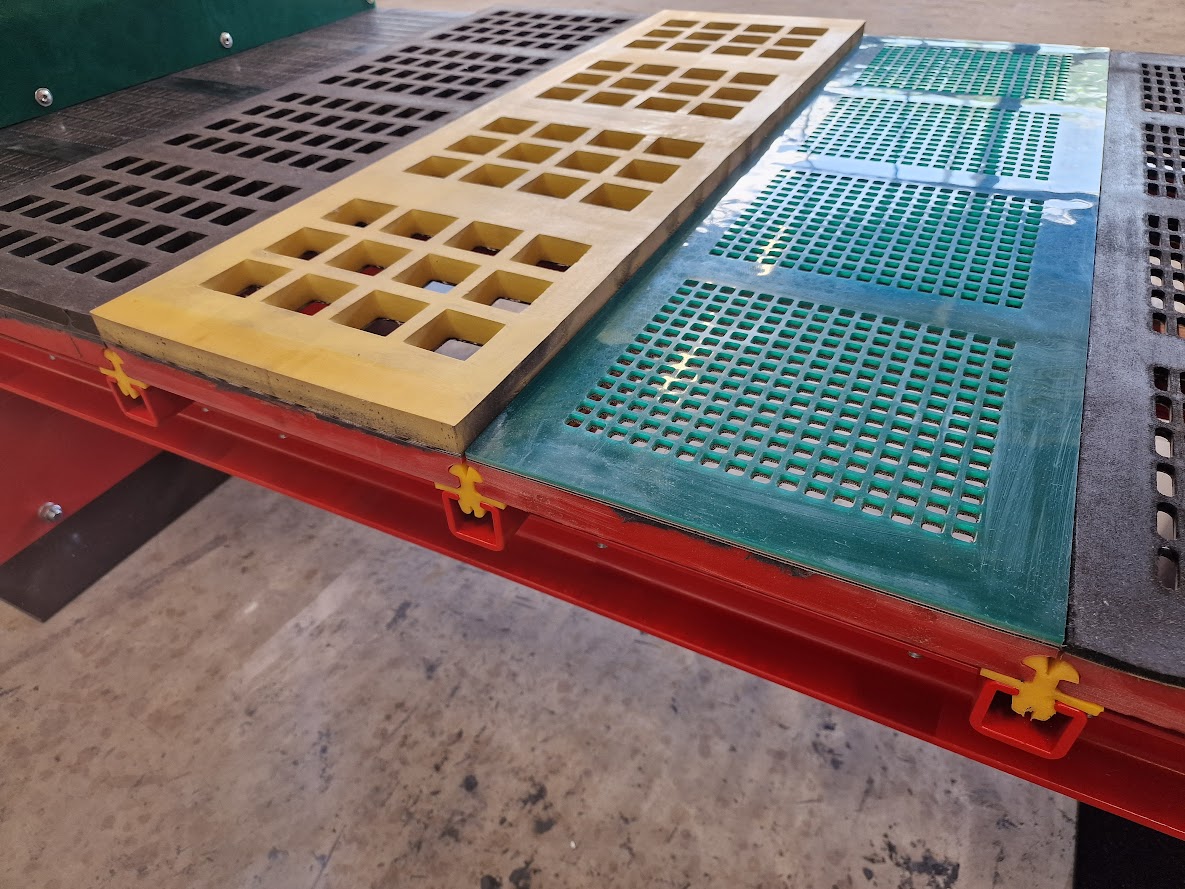
REMASCREEN screen liners from TIP TOP Jörns, a REMA TIP TOP Group subsidiary, are specifically designed for demanding classification tasks in the bulk materials industry. These liners do not only extend the service life of screening media, but also stabilize the entire screening process under high mechanical stress.
Numerous processing lines still use traditional wire or steel screens. However, these systems tend to exhibit weaknesses under demanding operating conditions. Moist or cohesive materials often clog the screen openings due to clumping, and abrasive aggregates accelerate wear on the screen surfaces. With moist, fine-grained fractions in particular, it is often the increasing clogging rather than the wear itself that becomes the actual performance challenge for the screen decks.
As clogging increases, the open screen area, separation efficiency, and throughput all decrease simultaneously. Concurrently, cleaning efforts and downtime increase, and frequent screen changes tie up personnel and maintenance resources. "Many operators still view screening media primarily as a wear part," explains Matthias Klem, Managing Director at TIP TOP Jörns. "In fact, they significantly impact the stability of the material flow and, consequently, the efficiency of the entire processing operation."
Especially in hard rock, sand, and gravel processing, even brief interruptions have an immediate impact on the performance of the entire line. Consequently, the demands placed on the screening media used are correspondingly high.
This is exactly where elastomeric screen linings come into play. Unlike rigid steel screens, flexible materials respond dynamically to the vibrational movements of the screening machine. The resulting natural movement of the screen surface prevents critical particle size fractions from becoming permanently lodged in the screen openings.
The self-cleaning effect significantly reduces material buildup and stabilizes the open screen area, even with moist or difficult-to-classify materials. In many applications, the portion of the screen area that remains usable over the long term determines actual plant performance more than the nominal screen area does. Consequently, separation efficiency and screening performance remain constant over extended operating periods.
At the same time, elastomeric materials offer high abrasion resistance. They are therefore particularly well-suited for high-stress applications in natural stone, sand, and gravel processing. Depending on the feed material and operating conditions, different grades of rubber or polyurethane, as well as varying degrees of hardness, are used.
The geometry of the screen openings also has a significant impact on screening performance. The shape of the holes, their arrangement, and the material composition play a key role in determining how the bulk material behaves on the screen deck. By carefully adjusting these parameters, classification processes can be designed with significantly greater precision than with standardized solutions. "Material properties, particle size ranges, and moisture content can vary significantly from one plant to the next," says Matthias Klem. "This is precisely why standard screens often reach their technical and economic limits."
Every screening solution starts with an analysis of the specific operating conditions. Evaluated factors include particle sizes, material properties, moisture content, throughput rates, and mechanical stresses. Based on this analysis, we develop a custom-configured solution for your application.
The Allendorf/Eder-Somplar facility allows for a high degree of manufacturing flexibility. There are approximately 2,000 punching dies available for production, with more than 550 different hole sizes and shapes ranging from 0.4 to 200 millimeters. CNC-controlled automatic punching machines and digital quality control ensure precise, repeatable manufacturing, even for complex geometries.
Thanks to large storage capacities and flexible production processes, short-notice requests can also be fulfilled quickly. This is a crucial factor, especially in the raw materials industry, where unplanned plant downtime can have significant economic consequences.
Real-world example:
A real-world example from the industry illustrates just how significantly custom-designed screening media can impact a plant’s economic efficiency. At a Danish cement plant, a mixture of chalk slurry and crushed flint had to be screened. This material is characterized by high abrasiveness and pronounced grain agglomeration.
The wire screens had a service life of only three to four days. This was due to severe clogging and high abrasive wear. Additionally, the regular screen changes required over 400 hours of work annually.
Using optimized screen frames and highly hydrolysis-resistant PU longitudinal tensioners made it possible to stabilize the open screen area permanently. The service life increased to over one year, and the time required for screen changes decreased to approximately 36 hours per year. According to the company, the investment paid for itself within seven months.
In addition to significantly lower maintenance costs, the operator benefited above all from more consistent maintenance intervals and higher system availability.
As the demand for resource efficiency and production reliability continues to rise, the precise design of screening media is becoming increasingly important. A longer service life reduces material consumption and the need for replacement parts while improving the predictability of maintenance work and the availability of complex processing lines.
The sound-dampening properties of elastomeric materials provide additional benefits. The company claims that noise levels can be reduced by up to 20 decibels (dB) compared to traditional steel screens. This improves working conditions and minimizes the need for additional noise reduction measures.
For quarry and gravel plant operators, screening technology is evolving from a traditional wearand- tear issue into a key factor in optimizing modern raw material production. Customdesigned screening media are crucial for ensuring long-term separation efficiency, consistent throughput, and plant availability.